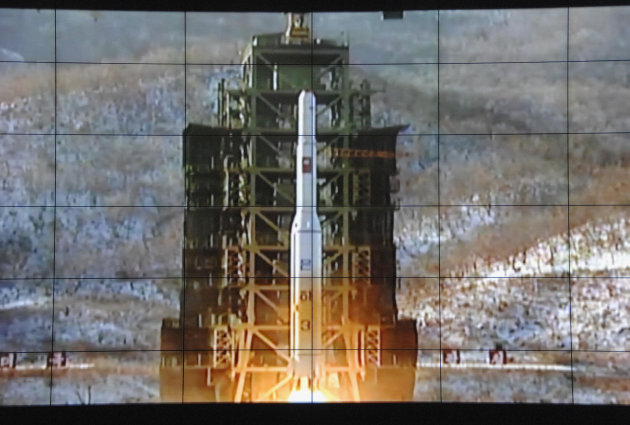
The US believes North Korea's satellite is out of control, but the South Koreans insist that it is functioning normally.
US
and South Korean officials appear to disagree on one detail of the
North Korean satellite that has nothing to do with any difference over
what to do about it.
No sooner had major American
television networks spread the word from their official sources that the
satellite was “out of control” than South Korea’s defense ministry came out with just the opposite view.
Ministry spokesman Kim Min-seok,
briefing South Korean reporters, told them that, “for the time being,”
the satellite is “working normally.”
That word seemed to snuff out the
image of the satellite wobbling off course as it circles the earth in
what the ministry says is an oval pattern. The satellite, says the
ministry, takes 95.4 minutes to complete an orbit at a speed of about
four miles per second.
The difference in analysis
appears to revolve around what kind of orbit the satellite is in as it
whirls about 300 miles above the earth’s surface.
Lee Sung-yoon, professor at Tufts University’s Fletcher School in Medford, Mass., argues that North Korea
has “not yet developed a fully functioning satellite despite their
apparent success in ballistic propulsion technology.” Yonhap, the South
Korean news agency, reports that analysts at the Korean Aerospace Research Institute
believe North Korean engineers aimed to put the satellite in a circular
orbit, but that it’s now in an elliptical orbit. That doesn’t mean,
they say, that it’s “out of control.”
The institute's Lee Kyu-su says
the North Koreans could correct the course of the satellite, which
weighs 100 kilograms (about 220 pounds), with the help of a small
booster, which the North Koreans don’t have.
The big mystery, according to Mr.
Kim at the defense ministry, is what the North Korean satellite is
really doing up there. “It is not yet known what kind of mission the
satellite is conducting,” he says. “It usually takes two weeks to
evaluate whether a satellite is successful.”
US and South Korean officials are
less concerned, however, about the equipment the satellite is carrying
and what it’s supposed to accomplish than about the implications of the
North’s ability to fire such an object from a long-range rocket or
missile.
All that’s needed to turn the
North Korean rocket into a vehicle for mass destruction, they say, is to
substitute a warhead for the satellite.
The net result for US policy, predicts Nicholas Eberstadt at the American Enterprise Institute, is that “Washington will try to cut a deal with Pyongyang – again.”
“The problem,” says Mr. Eberstadt, a prolific author of studies on
North Korea, “is we don't have anything offer that they really want –
apart from South Korea.”However, according to experts visiting Seoul for a conference of the Asan Institute here, the North Koreans may not be all that advanced in their program, even though the three-stage rocket has a theoretical range of about 7,500 miles – enough to carry a warhead as far as the US West Coast.
Vassily Mikheev, from Russia’s Institute for World Economy and International Relations, says the reliance on old technology means the launch is “a failure.” Mr. Mikheev, at the Asan conference, says the Scud technology is “for small missiles” – and therefore not reliable when they’re bundled in three distinct stages.
“There will be discussion on how successful the launch was,” he says. “The Americans exaggerate to get funding for their own antimissile system.”
Douglas Paal at the Carnegie Endowment disputes that view. “The US has a genuine and reasonable concern that North Korea on its own may be able to threaten its neighbors,” he says. North Korea, he says, “has a nuclear capability.”
Though China
is clearly the country with the greatest influence over Pyongyang, Mr.
Lee at the Fletcher School doubts if China can stop North Korea from
pressing ahead with its missile and nuclear programs.
“North Korea has never caved into Chinese pressure,” he says.
“Watch out,” he advises, "for a
follow-up provocation soon – in the next day or two" in the run-up to
the first anniversary on Dec. 17 of the death of leader Kim Jong-il and South Korea’s presidential election two days later.
South Korean officials say they
now are planning to bolster their antimissile system in view of the
threat posed by North Korea, which purportedly has scores of mid and
short-range missiles capable of easily striking all the Korean peninsula and Japan as well.
In the meantime, South Korean warships are scouring the Yellow Sea
for debris from the first stage of the North Korean rocket that
plummeted southwest of the Korean peninsula two minutes and 36 seconds
after liftoff.
So far they’ve spotted a fuel canister that divers are trying to
recover from a depth of about 250 feet. The North Koreans, says the
defense ministry spokesman, are not going to get it back.
"We are not obligated to return it,” he says, since it’s “an enemy's weapon.” LINK


 Posts
Posts